
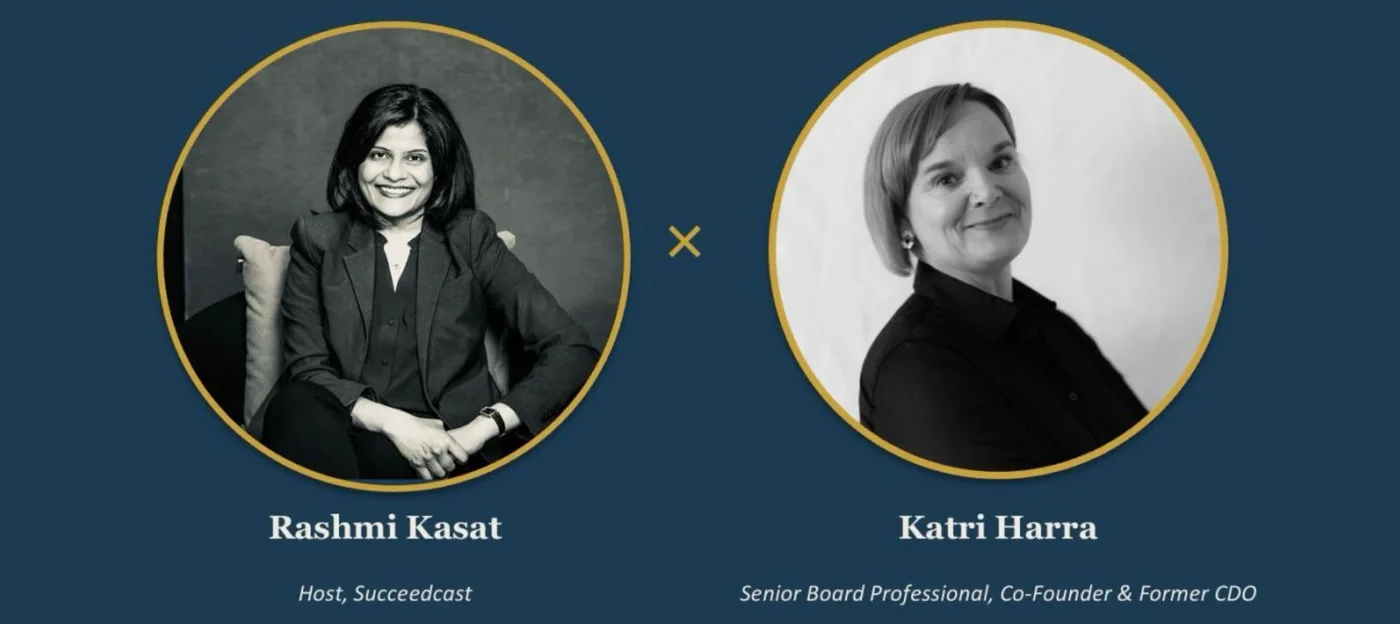
My guest for this episode of Succeedcast was Katri Harra: former Chief Digital Officer of Finnair and Kojamo, a senior board professional with a career spanning across aviation, media, retail and consulting, and nowadays as a co-founder of Grip Strategy.
It’s one of the richest conversations we’ve had on the show, so I’m giving it the full write-up it deserves.
What actually carried the Finnair transformation
Katri was direct about it: the technology was never the hard part. During her time as CDO of Finnair, she transformed the airline’s tech stack in the back and front end to be relevant for the digital era. The Finnair app went on to win a Red Dot design award.
The KPI she trusted most wasn’t revenue or adoption numbers nor even the awards themselves- those were the end results of the transformation. It was how eager and positive the workforce felt about picking up new technology and carrying the change forward themselves. When that number moved in the right direction, she knew the transformation was taking root culturally, not just technically. It took about a year or two to get there, alongside a healthy 8% CAGR and Finnair’s best-ever result at the time.
The key success factor was that the whole management was putting their weight behind the digital transformation, visibly and collectively supporting the change across the organization.
Boards and AI: value creation and value preservation
We spent real time on how boards should actually engage with AI, and Katri’s framework is simple and useful. Every board conversation about AI has two dimensions: value creation (how AI changes your products, customers, processes and business model) and value preservation (regulation, privacy, security, the risks that come with the upside). Boards are responsible for both, and neither should crowd out the other.
Her clearest point: no strategy cycle should go through the next round without a real answer for how AI changes the plan. Not a bolt-on AI strategy document, necessarily, rather an integrated company strategy that actually accounts for the future impact of AI. There’s no universal AI playbook. What works depends entirely on the industry and the company.
You can’t write an AI strategy without experimenting first
Katri told a story where she started one of her first formal AI strategy projects a long time ago and stopped it almost immediately, because the team realized they didn’t have enough hands-on experience with the technology to write a credible strategy around it. So they went and experimented first.
That created a real tension she’s lived on both sides of: boards and management want to see results, but experimentation takes patience, and innovation is rarely an overnight thing. The tools that look like sudden breakthroughs, ChatGPT included, usually sit on years or decades of unseen investment. Her advice is to stay aware of cost, but be patient with results, and to be willing to kill your own initiatives when they’re not working.
The number one value destroyer
I asked Katri what single AI capability, or its absence, creates or destroys the most value. Her answer: the distance between technology teams and business teams. When the two sides don’t share a language or work daily alongside each other, that gap is where value quietly leaks out.
It’s a big part of why she co-founded Grip Strategy, a consultancy built around three lenses: technology’s strategic role, leadership and management systems, and strategy itself. The goal is to get business and technology people talking to each other again, not solving problems in separate rooms.
Business models need a rethink too
On whether business models need an upgrade for the agentic era, Katri’s answer started with value creation and systems thinking, not technology. Her example: IT consultancy shifting away from selling time and projects toward selling the value of a solution. Her advice for any company wrestling with this: look at what AI-native start-ups are doing, and figure out how to bring those lessons into the enterprise fast, rather than waiting to be disrupted by them.
Her three recommendations, plus a bonus
I closed by asking Katri for three concrete recommendations for leaders trying to strategize, lead and govern their AI transformation. She nailed those down and even provided a bonus tip:
- Get outside your usual circle. Talk to five or six people who are not in your position: different functions, different companies, different vantage points. Sticking with the same trusted crowd means you don’t get fresh perspectives.
- Redraw your company as if it were a start-up. Take half a day and imagine you’re building your business from scratch today, with everything you now know about AI. What structure would you actually choose, unconstrained by the history that built the one you have?
- Stay curious and stay in the conversation. You don’t need to master every model or tool out there. You do need to keep reading, listening and experimenting enough to know where the world is heading.
- An important bonus tip: put your ego aside. Every experienced leader has a way of doing things and has learnt from a pre-AI era. That experience is valuable, but in the fast changing context of AI, that experience can sometimes also become a hurdle or often be insufficient. In a fast changing world, you cannot possibly have all the answers hence the need to remain open-minded and receptive to new ideas. Stay humble, stay curious, and be willing to adapt.